Own the building
One resident owner could own a single-family home or a small multi-unit building and rent other dwellings, subject to applicable rules and financing.

HOMES & OWNERSHIP / VISUAL STUDIES
Building form and ownership are separate choices. The right answer begins with the place and the people.
Start with the land ↗AI-generated architectural illustration. Not an actual property, completed project or approved plan.
A GALLERY OF POSSIBILITIES
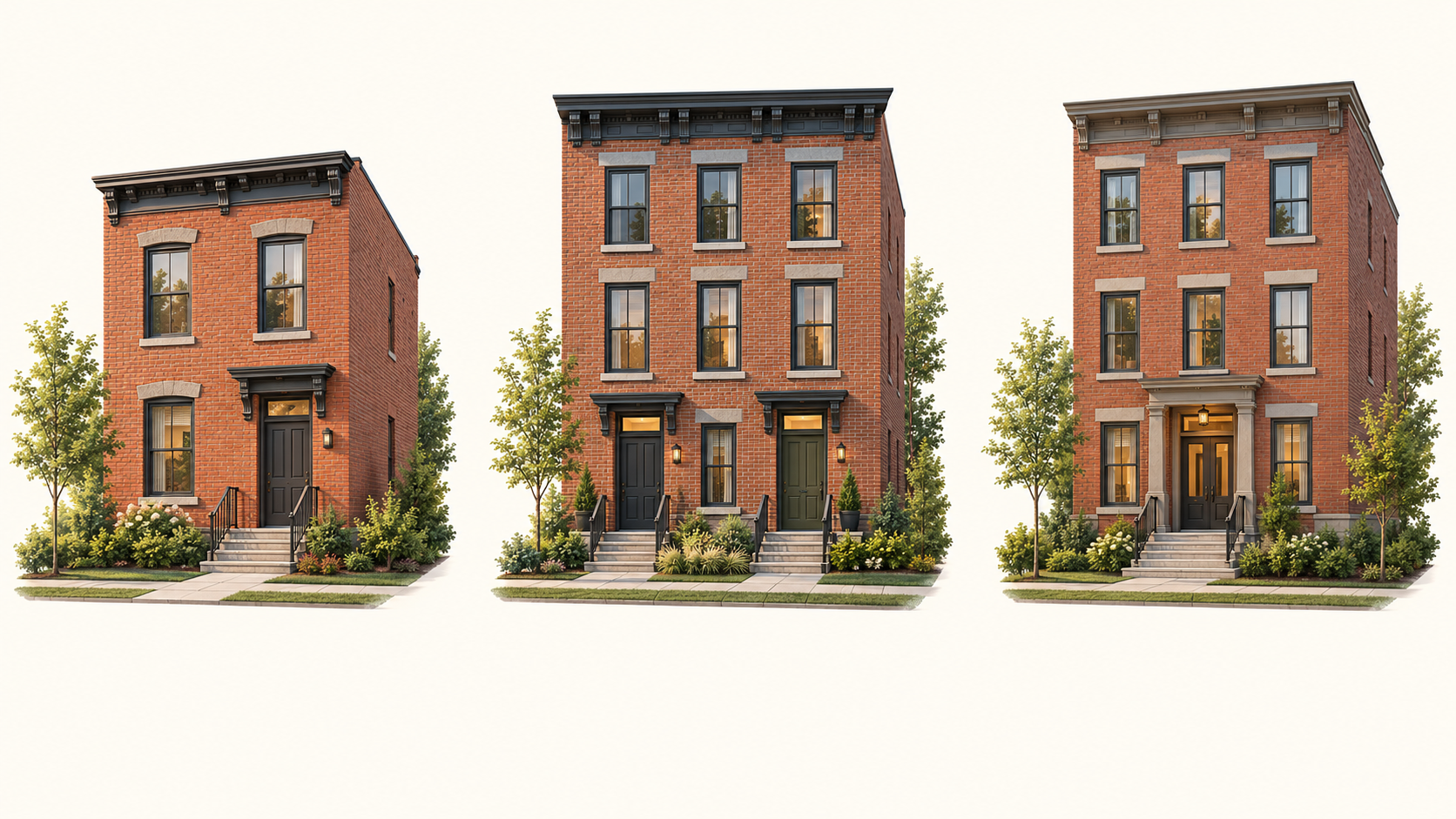
Compare conventional, modular and panelized construction where suitable. Give rehabilitation equal consideration: an older house may be the strongest starting point for its block. No construction method or all-in build price has been established.
ONE BUILDING / TWO HOUSEHOLDS
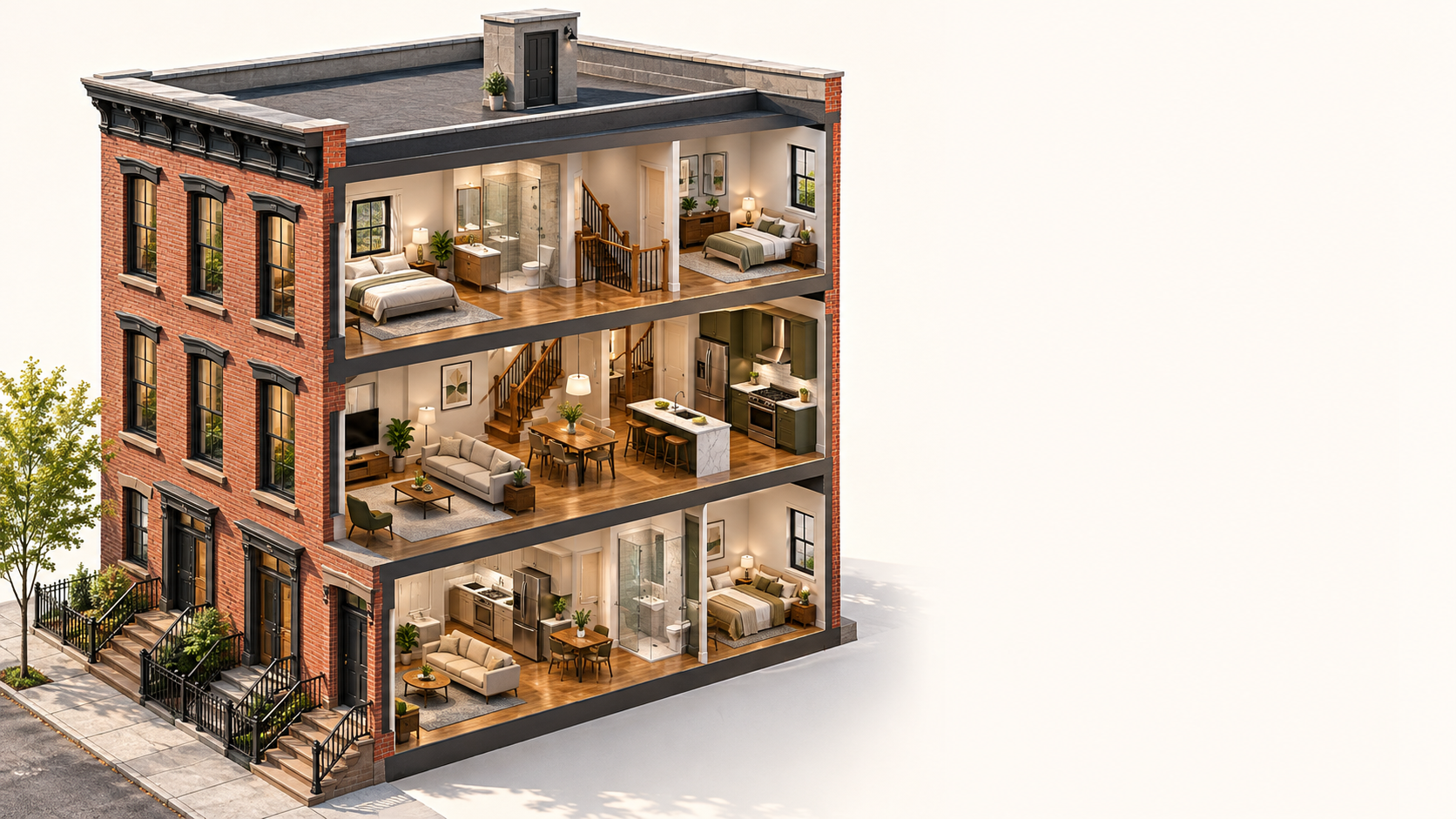
The owner’s preferred example: a two-bedroom, one-bath lower apartment beneath a three-bedroom, two-and-a-half-bath home across two upper floors, with possible roof access.
A buyer might live upstairs and rent the separate lower dwelling. This is a spatial idea—not an approved layout, verified room count or financing promise.
A SHORT VISUAL PRESENTATION
9-second motion presentation of the saved concept drawing. Camera movement across a still illustration; not LTX-generated motion, a construction video or a validated floor-plan walkthrough. No audio.
FROM AN IDEA TO A DESIGN BRIEF
Henry is the selected professionally drawn layout reference. The lower apartment and upper home are independent dwellings; the upper home spans two floors.
Lower: two bedrooms and one bathroom. Above: three bedrooms and two-and-a-half bathrooms over two floors. Overall dimensions, local fit and roof access remain unconfirmed.
View the builder's actual floor plan ↗
Drawing copyright belongs to its owner. Linked for reference; no reproduction or construction permission is claimed. The builder may show a security-verification page before opening the drawing.
THE SAME BUILDING. DIFFERENT WAYS TO OWN.
One resident owner could own a single-family home or a small multi-unit building and rent other dwellings, subject to applicable rules and financing.
Separate buyers could own individual units and share common property. Albany already has condominiums; this suggests exploring smaller neighborhood applications, not inventing the ownership form.
A resident corporation owns the property. Members hold shares and occupancy rights. Monthly charges, building debt and repair reserves matter alongside the share price.
Limited-equity ownership or a community land-trust relationship could preserve access for future households. Resale restrictions may limit appreciation. These are options to explore with experienced partners.
STAY. CARE. PARTICIPATE.
Discuss five to seven years of primary residence, without shortening longer program protections. Residence, ownership retention, affordable rent and resale limits are different obligations.
Encourage clear, realistic upkeep expectations and support for necessary repairs. Renters also sustain strong neighborhoods. Homeownership alone is not a guarantee of safety or a cure for crime.
Shared buildings also need workable decisions about insurance, maintenance and reserves. Two-owner associations need particular care to avoid deadlock.
Voucher homeownership, mortgages and grants need separate eligibility review. A whole duplex is not interchangeable with an individual condo/co-op unit under standard HUD homeownership rules. No benefit approval is represented.
MORE OPTIONS TO DISCUSS
Explore accessory apartments and suitable conversions as well as new buildings. Ask about repair support for existing homeowners, protections for residents during rehabilitation, and NYSERDA or other eligible energy assistance. Additional rental supply does not automatically mean an affordable rent. These are questions for local review, not approved designs or funding.
IDEAS FOR DISCUSSION / OCTOBER 18 REVIEW
Rehabilitation and compatible infill should both respond to residents and the place.
Compare repair and rehabilitation with replacement before choosing demolition. Consider building condition and possible lead or asbestos hazards. For occupied homes, ask about tenant communication, lawful relocation where needed and avoiding displacement. Lasting resident ownership, rather than rapid resale, is the intended direction.
Compare single-family homes, duplexes, triplexes, condominiums and cooperatives. Accessory apartments or suitable conversions could offer another route where local rules and the building allow. Consider accessible or ground-floor living, changing household needs and the costs of shared ownership.
Existing renters and homeowners should help shape the discussion. Pair upkeep expectations with possible repair support, and ask about displacement or assessment pressures on existing residents. Seek tenant-to-owner counseling without promising priority, a grant or an affordable rental outcome.
IDEAS FOR DISCUSSION / OCTOBER 18 REVIEW
Fair expectations, owner preparation and constructive feedback are suggestions to develop together.
Consider illness, disability, caregiving, bereavement, inheritance, divorce, relocation and foreclosure-related circumstances when discussing temporary absence or early sale. Pair realistic upkeep with possible repair support. Longer program terms and lender rights still apply; no exception or assistance is granted here.
Explore mentoring on leases, responsibilities, vacancies and repair planning before buyers rely on rent. Invite tenant-to-owner counseling and protections against displacement. Owner occupancy does not automatically make rents affordable; applicable assistance conditions would govern. No universal rent cap or funded reserve program is adopted.
Ask for a sourced correction, an existing effort to complement, a resident concern, a site issue and an idea to develop or drop. Invite neighborhood groups, meetings and accessible formats as well as replies to infill@simionmgmt.com. Record feedback and explain changes. No automatic reply or deadline is promised.
PRIVATE REVISED IDEAS
Different ownership forms need different financing and resident protections.
Discuss five to seven years of primary residence, without shortening longer applicable program terms. Ownership, residence, rental affordability and resale restrictions are different obligations. Repair support and fair hardship treatment belong in the discussion.
Small-scale condo or co-op ownership could allow separate resident purchases where the legal structure, association responsibilities and financing are workable. Albany already has condominium examples; this is an idea for broader neighborhood use.
Standard HUD voucher homeownership rules identify a one-unit property or a single condo/co-op dwelling. A purchase of an entire two-family building is a different question. Ask the administering agency and lender about the exact property and program; no HOT-PHA, mortgage or grant approval is claimed.
SELECTED LAYOUT REFERENCE
A Canadian builder reference selected to illustrate the arrangement. It does not establish modular manufacture or New York code compliance.
Authentic Developments describes a separate 727-square-foot basement suite with two bedrooms and one bathroom. Its published drawing shows the room arrangement and stair relationship.
The main and second floors together provide 1,422 square feet, three bedrooms and two-and-a-half bathrooms. This is the arrangement Garry selected as the preferred reference.
Confirm whether the basement suite has its own exterior entrance and stair access separate from the upper home. Overall width and depth are not stated in the available image. Setbacks, basement suitability and roof access need review. Matching room counts does not establish fit on a 25-by-100-foot lot.
Open the actual builder drawing ↗
Reproduction and construction rights remain unconfirmed. The drawing is linked at its original source.
EXPLORE THE NUMBERS
Change a home price, location and household budget. Explore local assistance, voucher assumptions and the monthly share you would need to cover.
Program leads and conditional examples are not approvals. Your inputs stay in your browser unless you choose to save or share a file.
Open the Homebuying Explorer ↗LOCAL ROOTS. AN OPEN CONVERSATION.
infill@simionmgmt.com